Sampling-Frequency-Independent Deep Learning
We propose a DNN-based audio source separation method that can consistently work for audio signals of arbitrary (unseen) sampling frequencies, even if it is trained with a single sampling frequency. Focusing on the fact that a convolutional layer is interpreted as a digital FIR filter, we build a sampling-frequency-independent convolutional layer, of which weights (the impulse responses of the digital filters) are generated from latent analog filters using a classical DSP technique, digital filter design.
- Kanami Imamura, Tomohiko Nakamura, Norihiro Takamune, Kohei Yatabe, and Hiroshi Saruwatari, “Stride conversion algorithms for convolutional layers and its application to sampling-frequency-independent deep neural networks,” Signal Processing, vol. 242, Nov. 2025.
- Kanami Imamura, Tomohiko Nakamura, Norihiro Takamune, Kohei Yatabe, and Hiroshi Saruwatari, “Local equivariance error-based metrics for evaluating sampling-frequency-independent property of neural network,” in Proceedings of European Signal Processing Conference, Sept. 2025, pp. 276–280.
- Kanami Imamura, Tomohiko Nakamura, Kohei Yatabe, and Hiroshi Saruwatari, “Neural analog filter for sampling-frequency-independent convolutional layer,” APSIPA Transactions on Signal and Information Processing, vol. 13, no. 1, e28, Nov. 2024.
- Kanami Imamura, Tomohiko Nakamura, Norihiro Takamune, Kohei Yatabe, and Hiroshi Saruwatari, “Algorithms of sampling-frequency-independent layers for non-integer strides,” in Proceedings of European Signal Processing Conference, Sept. 2023, pp. 326–330.
- Koichi Saito, Tomohiko Nakamura, Kohei Yatabe, and Hiroshi Saruwatari, “Sampling-frequency-independent convolutional layer and its application to audio source separation,” IEEE/ACM Transactions on Audio, Speech, and Language Processing, vol. 30, pp. 2928–2943, Sept. 2022.
- Koichi Saito, Tomohiko Nakamura, Kohei Yatabe, Yuma Koizumi, and Hiroshi Saruwatari, “Sampling-frequency-independent audio source separation using convolution layer based on impulse invariant method,” in Proceedings of European Signal Processing Conference, Aug. 2021, pp. 321–325.
Empirical Bayesian Independent Deeply Learned Matrix Analysis
We propose an extension of independent deeply learned matrix analysis (IDLMA), empirical Bayesian IDLMA, that can deal with uncertainty of source power spectrogram estimates at each time-frequency bin using DNN-based hyperparameter estimation of prior distributions of sources.
- Takuya Hasumi, Tomohiko Nakamura, Norihiro Takamune, Hiroshi Saruwatari, Daichi Kitamura, Yu Takahashi, and Kazunobu Kondo, “Empirical bayesian independent deeply learned matrix analysis for multichannel audio source separation,” in Proceedings of European Signal Processing Conference, Aug. 2021, pp. 331–335.
Independent Deeply Learned Tensor Analysis
We propose a multichannel audio source separation method based on independent deeply learned matrix analysis, independent deeply learned Tensor Analysis, that can deal with inter-frequency correlations of each source explicitly.
- Naoki Narisawa, Rintaro Ikeshita, Norihiro Takamune, Daichi Kitamura, Tomohiko Nakamura, Hiroshi Saruwatari, and Tomohiro Nakatani, “Independent deeply learned tensor analysis for determined audio source separation,” in Proceedings of European Signal Processing Conference, Aug. 2021, pp. 326–330.
Multiresolution Deep Layered Analysis: End-to-end Music Source Separation Inspired by Multiresolution Analysis
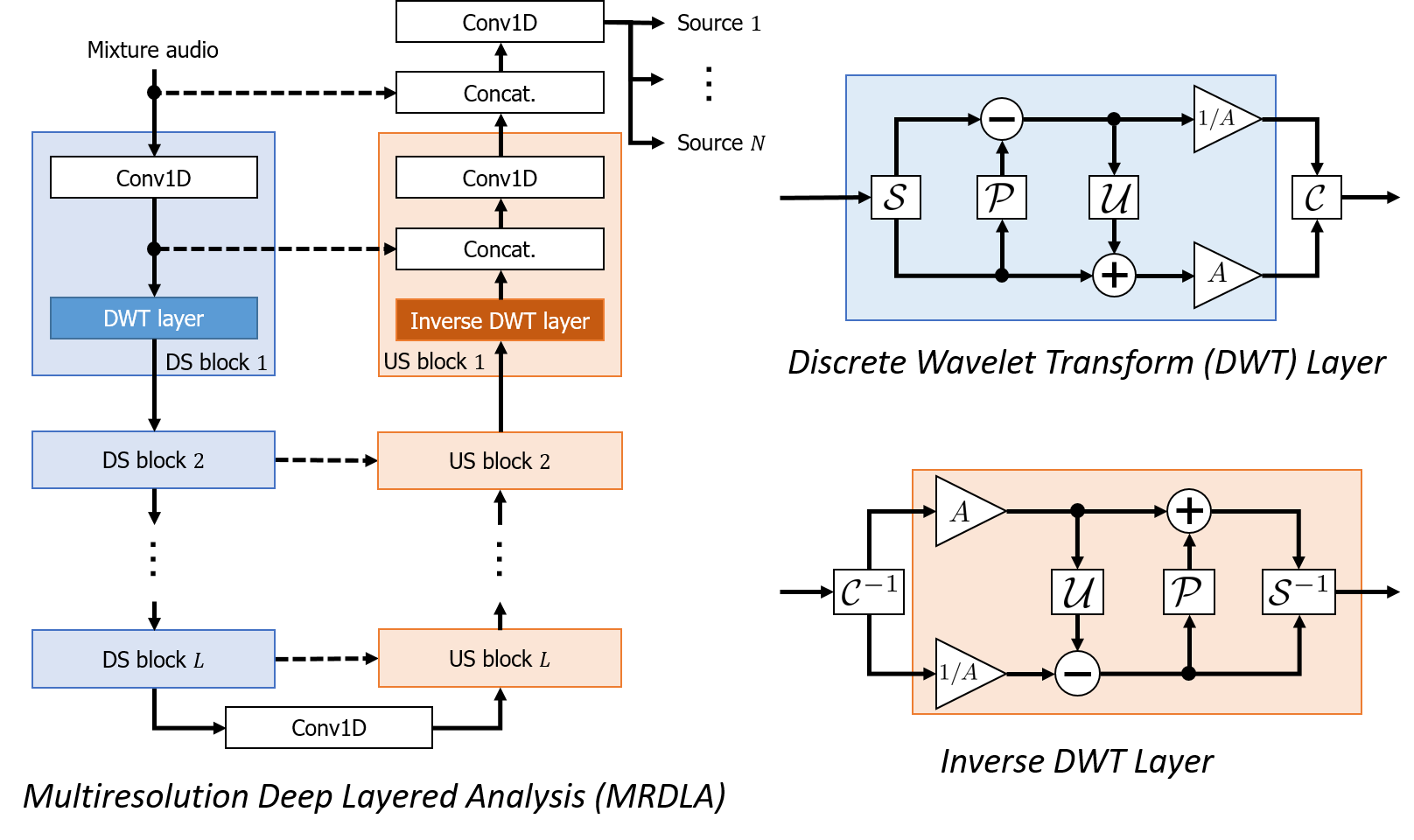
Focusing on the architectural resemblance between an DNN for end-to-end audio source separation and multiresolution analysis, we propose down-sampling (pooling) layers "reasonable" from the signal processing viewpoint, which has the perfect reconstruction property and the anti-aliasing mechanism. Using the proposed down-sampling layers, we further propose a multiresolution-analysis-inspired end-to-end audio source separation method, multiresolution deep layered analysis.
- Tomohiko Nakamura, Shihori Kozuka, and Hiroshi Saruwatari, “Time-domain audio source separation with neural networks based on multiresolution analysis,” IEEE/ACM Transactions on Audio, Speech, and Language Processing, vol. 29, pp. 1687–1701, Apr. 2021.
- Shihori Kozuka, Tomohiko Nakamura, and Hiroshi Saruwatari, “Investigation on wavelet basis function of DNN-based time domain audio source separation inspired by multiresolution analysis,” in Proceedings of International Congress and Exposition on Noise Control Engineering, Aug. 2020, pp. 4013–4022.
- Tomohiko Nakamura and Hiroshi Saruwatari, “Time-domain audio source separation based on Wave-U-Net combined with discrete wavelet transform,” in Proceedings of IEEE International Conference on Acoustics, Speech, and Signal Processing, May 2020, pp. 386–390.
Harmonic-Temporal Factor Decomposition for Unsupervised Monaural Source Separation of Harmonic Sounds
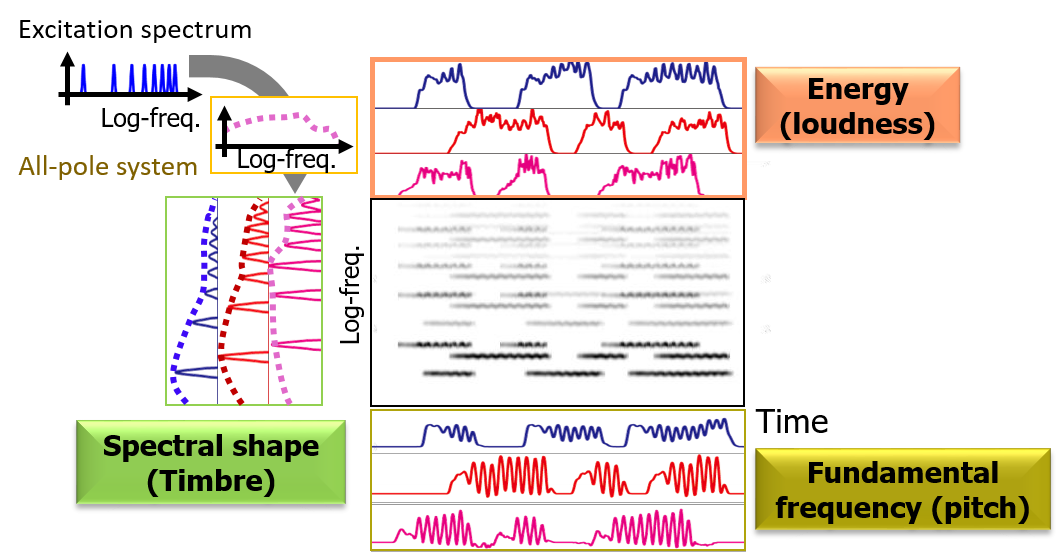
We present an unsupervised monaural source separation method of harmonic sounds, harmonic-temporal factor decomposition, that encompasses the ideas of computational auditory scene analysis, non-negative matrix factorization, and a source-filter model.
- Tomohiko Nakamura and Hirokazu Kameoka, “Harmonic-temporal factor decomposition for unsupervised monaural separation of harmonic sounds,” IEEE/ACM Transactions on Audio, Speech, and Language Processing, vol. 29, pp. 68–82, Nov. 2020.
- Tomohiko Nakamura, Kotaro Shikata, Norihiro Takamune, and Hirokazu Kameoka, “Harmonic-temporal factor decomposition incorporating music prior information for informed monaural source separation,” in Proceedings of International Society for Music Information Retrieval Conference, Oct. 2014, pp. 623–628.
Unsupervised Drum Timbre Replacement between Two Music Audio Recordings
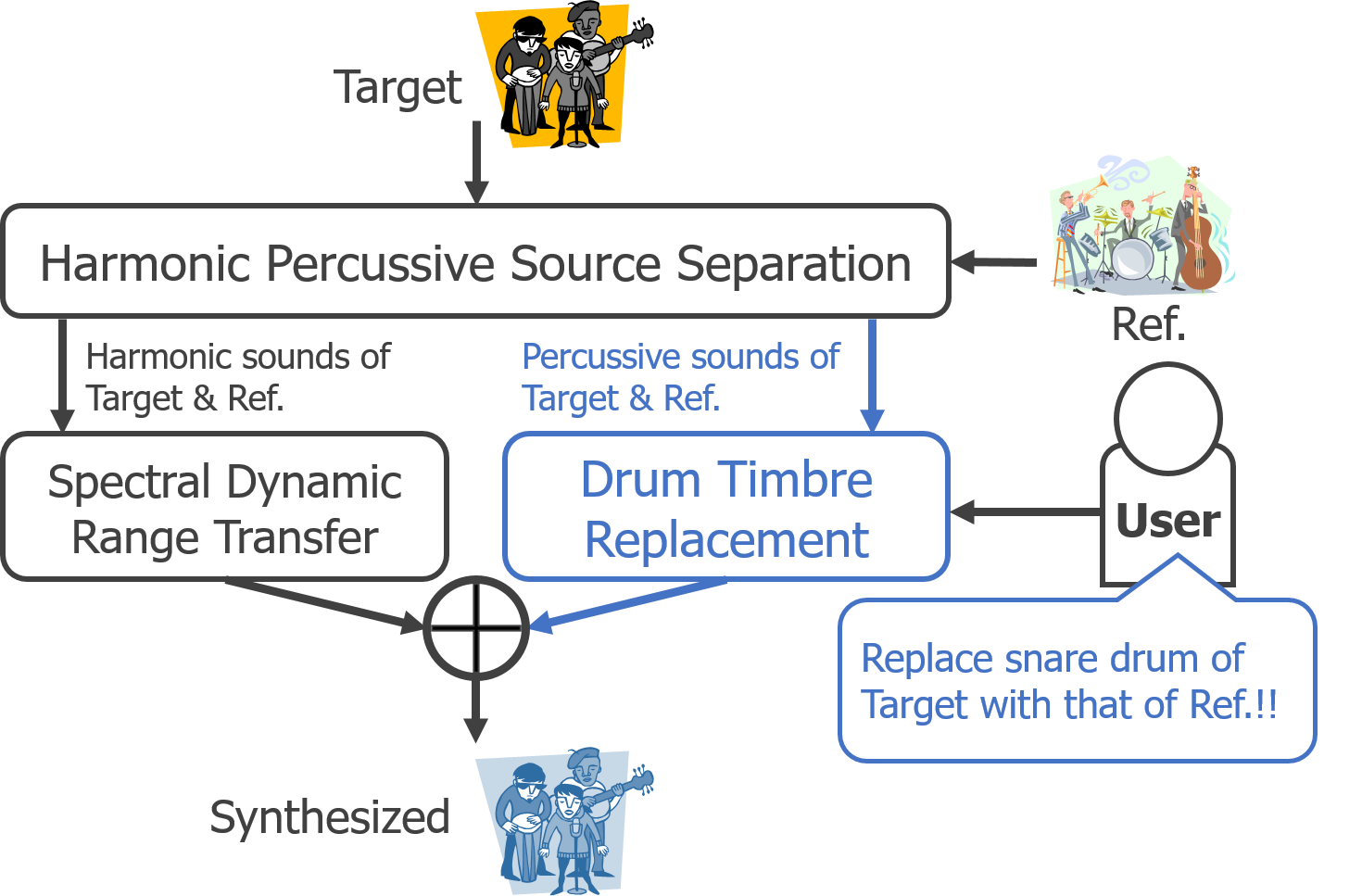
We propose a system that allows users to replace the frequency characteristics of harmonic sounds and the timbres of drum sounds of a music audio signal with those of another music audio signal without their musical scores.
- Tomohiko Nakamura, Hirokazu Kameoka, Kazuyoshi Yoshii, and Masataka Goto, “Timbre replacement of harmonic and drum components for music audio signals,” in Proceedings of IEEE International Conference on Acoustics, Speech, and Signal Processing, May 2014, pp. 7520–7524.
Fast Signal Reconstruction from Magnitude Spectrogram of Continuous Wavelet Transform
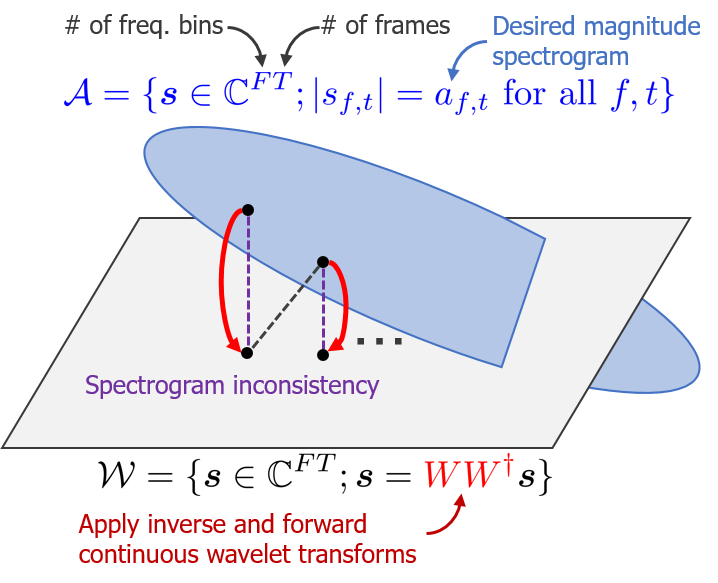
We propose a 100× faster signal reconstruction algorithm from a magnitude continuous wavelet transform spectrogram (a.k.a. constant-Q transform spectrogram).
- Tomohiko Nakamura and Hirokazu Kameoka, “Fast signal reconstruction from magnitude spectrogram of continuous wavelet transform based on spectrogram consistency,” in Proceedings of International Conference on Digital Audio Effects, Sept. 2014, pp. 129–135.
Score Following and Automatic Accompaniment for Musical Performance During Practice
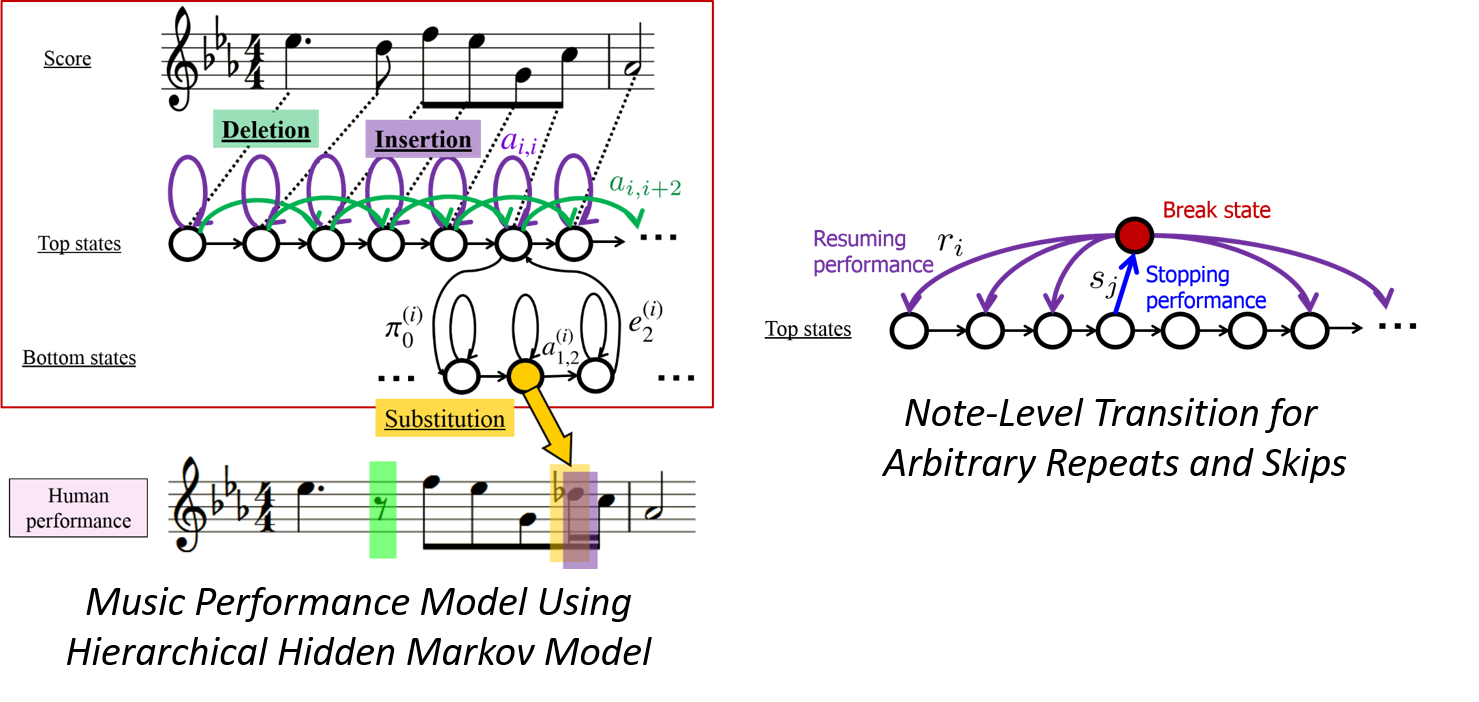
We propose real-time (O(n) for # of notes) score following methods that can deal with musical performances including typical errors during practice (note insertion, deletion, and substitution errors, and arbitrary repeats/skips).
- Tomohiko Nakamura, Eita Nakamura, and Shigeki Sagayama, “Real-time audio-to-score alignment of music performances containing errors and arbitrary repeats and skips,” IEEE/ACM Transactions on Audio, Speech, and Language Processing, vol. 24, no. 2, pp. 329–339, Feb. 2016.
- Tomohiko Nakamura, Eita Nakamura, and Shigeki Sagayama, “Acoustic score following to musical performance with errors and arbitrary repeats and skips for automatic accompaniment,” in Proceedings of Sound and Music Computing Conference, Aug. 2013, pp. 299–304.
- c.f. Eurydice (Related MIDI Score Following System)